The Vitruvian Man: Leonardo’s Study of Human Proportion and Influence
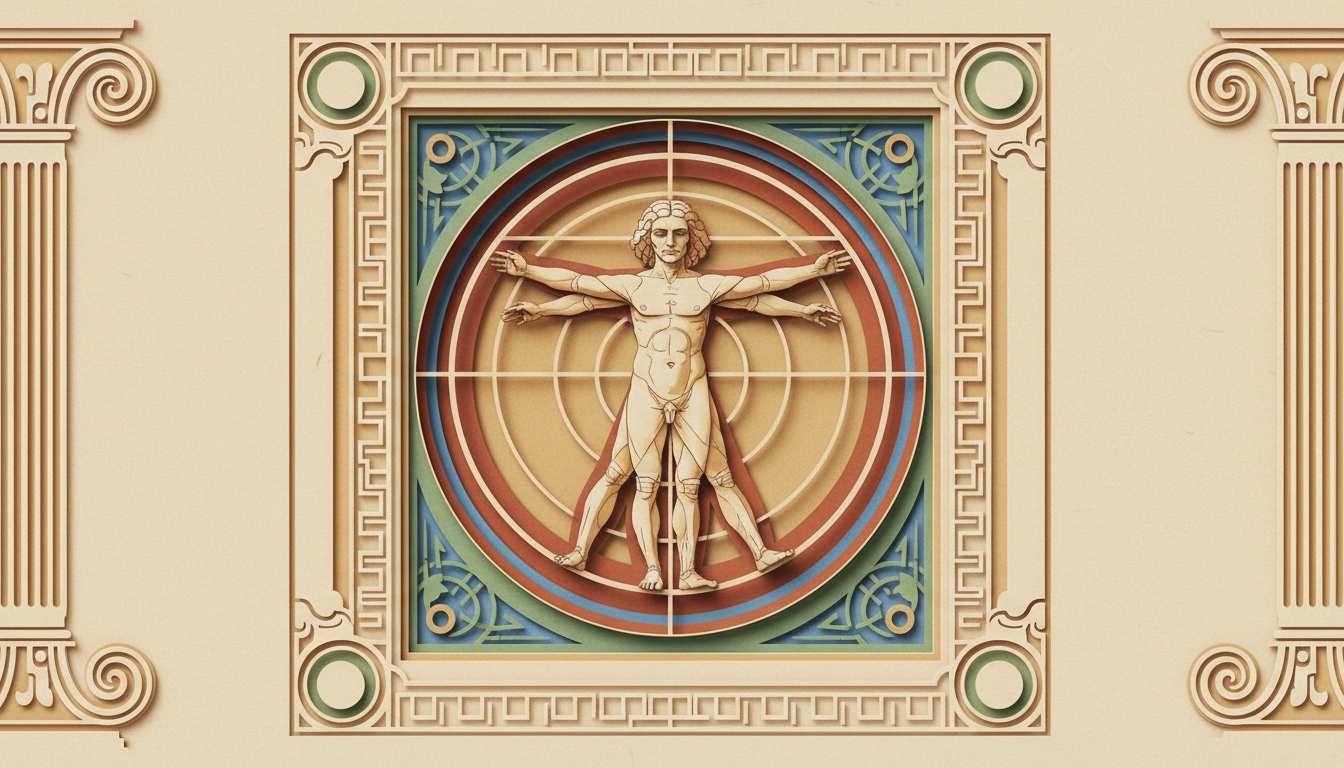
The Vitruvian Man is more than a drawing: it is a compact manifesto of Renaissance thinking, where art, science and antiquity converge. Executed by Leonardo da Vinci around c. 1490, the image pairs a precisely observed male nude with geometric forms — a circle and a square — and with a series of handwritten notes. The result is both a study in proportion and an emblem of humanist belief: that the human body reflects universal order.
From Vitruvius to Leonardo: Classical Roots
Leonardo’s drawing is a commentary on and visualisation of passages from the Roman architect Marcus Vitruvius Pollio (active c. 1st century BCE). In his treatise De Architectura (commonly called Vitruvius), the architect described ideal human proportions as a guide for architects designing temples and public buildings. Leonardo, steeped in classical learning and the revived textual scholarship of the Renaissance, sought to translate Vitruvius’ words into a precise, demonstrable image.
The Drawing: Date, Medium and Location
Leonardo made the Vitruvian Man around 1490 while living in Florence. The work is executed in pen and ink with subtle wash on paper and includes Leonardo’s characteristic mirror-writing at the margins. Today the sheet is part of the collection of the Gallerie dell’Accademia in Venice, where it is preserved under strict conservation conditions and only shown to the public intermittently because of its fragility.
Geometry and Anatomy: A Visual Translation
At first glance the composition is simple: a man is depicted twice — once with arms outstretched to form a horizontal line that fits a square, and once with arms raised and legs apart to inscribe a circle. But the meaning is layered. Leonardo wasn’t simply creating a clever visual trick; he was testing Vitruvius’ measurements against empirical observation. By placing the navel at the center of the circle, he showed how one geometric construction can emerge from the living proportions of a body.
Key Proportions Illustrated
Leonardo reproduced several of Vitruvius’ rules about proportions. These are approximations rather than fixed laws, and Leonardo’s notes and careful measurements emphasize observation over dogma. Examples include:
- Arm span equals height: a man’s outstretched arms measure approximately the same as his height.
- Head as a unit: the length of the head is roughly one-eighth of the total height.
- Centering through the navel: when arms and legs are extended, the navel becomes the center of a circle that can be drawn around the figure.
- Shoulder width and other ratios: various other fractions — for instance, the distance from the top of the head to the nipples or the proportions of the hand — serve as repeatable measuring units.
Technique and Notes
Leonardo combined scientific curiosity with draughtsmanship. His strokes are economical, the contours carefully observed. Surrounding the figure are notes in his mirrored handwriting — which scholars agree Leonardo employed out of habit, possibly to keep thoughts private or simply because he was left-handed and found it easier. These annotations cite Vitruvius and remark on the fractional relationships between parts of the body.
Symbolism: Circle, Square and Humanism
The choice of circle and square is not accidental. In medieval and Renaissance symbolism the circle often stood for the divine, the eternal and the cosmos; the square suggested the earthly, the measurable and the built environment. By fitting the human form into both, Leonardo implicitly argued that humanity bridges heaven and earth. The image thus became a visual statement of Renaissance humanism: humans as the measure of all things, drawing harmony between the natural world and intellectual order.
Reception and Legacy
Although the Vitruvian Man was not a public statement in Leonardo’s lifetime — it was a sheet among his notebooks — it has become one of the most reproduced images from the Renaissance. From textbooks and museum postcards to logos and medical diagrams, its powerful synthesis of art, science, and philosophy has made it an enduring symbol.
Artists admired Leonardo’s combination of observation and idealization; scientists and anatomists found in his careful proportional thinking a model for empirical study; and later thinkers used the image as an icon of liberal humanist education. In the twentieth and twenty-first centuries the drawing surfaced in popular culture as shorthand for human-centered design, medicine, and technological progress.
Conservation and Viewing
Because the sheet is made of paper and executed in ink, it is very sensitive to light, humidity and handling. The Gallerie dell’Accademia maintains strict conditions for its storage and exhibition, and the Vitruvian Man is shown only occasionally in curated displays or loaned out for high-profile exhibitions. When planning a visit to see the original, it is best to check the museum’s current exhibitions and loans schedule.
Why It Still Matters
More than five centuries after Leonardo’s hand set ink to paper, the Vitruvian Man endures because it crystallizes a way of thinking rather than merely a set of measurements. It embodies the Renaissance conviction that observation, mathematics and beauty are allied: that studying the human body can reveal truths about nature and about human potential. In classrooms, museums and design studios it continues to provoke questions about proportion, representation, and the relationship between art and science.
Conclusion: The Vitruvian Man remains a singular achievement — a drawing that is at once precise and poetic. Leonardo’s fusion of classical text, anatomical observation and geometric construction created an image that not only illustrates a series of proportional rules but also communicates a worldview: the human figure as a microcosm of universal order.